
A P2 pilot who spends 7-10 days flying Valle de Bravo with guided instruction will make more progress than 6 months of weekend flying at their home site. The combination of consistent conditions, daily flights, real-time radio coaching, and evening debriefs compresses months of learning into days.
Why Progression Stalls at Home
Most P2 pilots get stuck in a cycle that looks like this: fly Saturday if weather cooperates, maybe fly Sunday, then wait five days until next weekend. If weather is bad, you wait two weeks. If life gets in the way, it is three weeks. By the time you fly again, you have forgotten half of what you learned last time.
The result is slow, inconsistent progress. You re-learn the same basics every session instead of building on them. Bad habits form because there is no one watching your flying and correcting in real time. You plateau at a level that feels comfortable but is actually just familiar. The gap between P2 and P3 stretches from months to years.
This is not a criticism of the pilot. It is a criticism of the learning environment. Weekend-only flying at a single site with inconsistent conditions and no coaching is simply not an efficient way to progress. It works eventually, but it works slowly.
What P2 to P3 Actually Requires
The USHPA P3 (Intermediate) rating requires demonstrated proficiency in several specific areas:
- Thermal flying: Consistent ability to find, center, and climb in thermals. Not "sometimes I get lucky" but "I can read the sky and choose where to find lift."
- Flight planning: Assessing conditions, choosing destinations, making go/no-go decisions based on weather and skill level.
- Weather assessment: Reading the sky, understanding thermal development, recognizing when conditions are deteriorating.
- Emergency procedures: Rapid descent techniques, reserve deployment knowledge, landing in unfamiliar terrain.
- Cross-country fundamentals: Basic understanding of XC concepts even if you are not yet flying distance.
- Airtime: Simply having enough hours in the air to develop the instincts that come from repetition.
How Valle de Bravo Accelerates Each Skill
Thermal flying
El Penon's Hair Dryer thermal cycle provides consistent, well-organized thermals every day. You do not hope for thermals - you know they will be there. This means you practice thermal flying 20+ times in 10 days instead of 20 times over 6 months. And with radio coaching, every thermal attempt includes real-time feedback: "tighter turn, you are drifting out the back, hold that bank angle, now you are in the core." You build correct technique from the start instead of developing bad habits that take months to unlearn.
Weather assessment
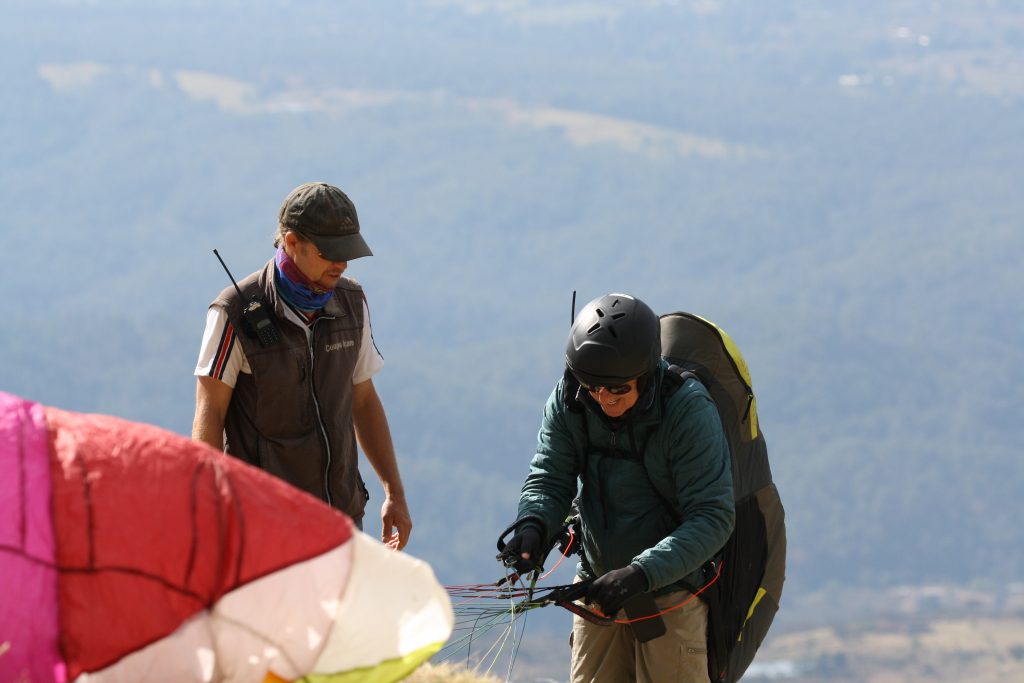
Daily ground school before each flying session teaches you to read the sky with a mentor standing next to you. Damien explains what the clouds mean, how the thermal cycle will develop today, and why conditions are different from yesterday. After 10 days of this, you have a practical understanding of weather that no textbook can give you. You learn to read weather by seeing it and flying in it daily, not by studying theory once a month.
Flight planning
Every day at Valle de Bravo involves planning: which thermals to target, how high to climb before transitioning, when to start thinking about landing. With guided instruction, you get coached through these decisions in the air and then review them in the evening debrief. The repetition of daily flight planning builds the judgment that P3 requires.
Emergency procedures
Practiced in a safe environment with instructor oversight. El Penon's wide launch and huge landing zones reduce the consequences of mistakes, which means you can practice maneuvers and techniques that would feel risky at a tight site.
Airtime
This is the simple math. Ten days at Valle de Bravo produces 20+ flights. At most home sites, that is 3-6 months of weekend flying. The concentrated airtime builds the muscle memory and instincts that only come from being in the air consistently.
The Math
A typical 10-day trip produces:
- 20+ flights (two per day on most days)
- 15-25 hours of airtime (compared to 3-5 hours per month at many home sites)
- 10 ground school sessions (weather, theory, flight planning)
- 10 evening debriefs (review tracks, analyze decisions, set goals)
- 200+ radio coaching interactions during flights
At a home site where you fly twice a month with 30-minute flights and no coaching, getting the equivalent of this experience would take 6-12 months. The compression of learning is the core value proposition.
What We Typically See
Most P2 pilots who complete a 7-10 day trip with us experience the following progression:
- Days 1-2: Orientation. You learn the site, get comfortable with the conditions, and Damien assesses your current skill level. Flights are shorter and more conservative.
- Days 3-4: The first breakthroughs. You start finding thermals deliberately instead of accidentally. Your centering improves visibly. Flights get longer.
- Days 5-7: Confidence builds. You are making thermal decisions on your own (with Damien confirming on the radio). You start thinking about where to fly next instead of just trying to stay up.
- Days 8-10: Integration. The skills feel more natural. You are reading the sky, planning your flights, and managing your altitude with growing independence. Your flying at this point looks qualitatively different from day one.
Coming Home: Maintaining Momentum
The trip gives you skills. Keeping them requires flying. When you get home, the worst thing you can do is wait three weeks to fly. Get back in the air as soon as possible. Even short local flights maintain the muscle memory and confidence you built in Valle de Bravo.
Talk to your local instructor about your P3 progression goals. Bring your track logs from Valle de Bravo - they document the skills you demonstrated. Many of the P3 task requirements may already be partially or fully met from your trip flights.
Ready to Fast-Track Your Progression?
The Thermalling Clinic is built for P2 pilots ready to level up. Or build a custom trip around your schedule. Read what P2 pilots need to know before visiting, and check what past pilots say about the experience.